
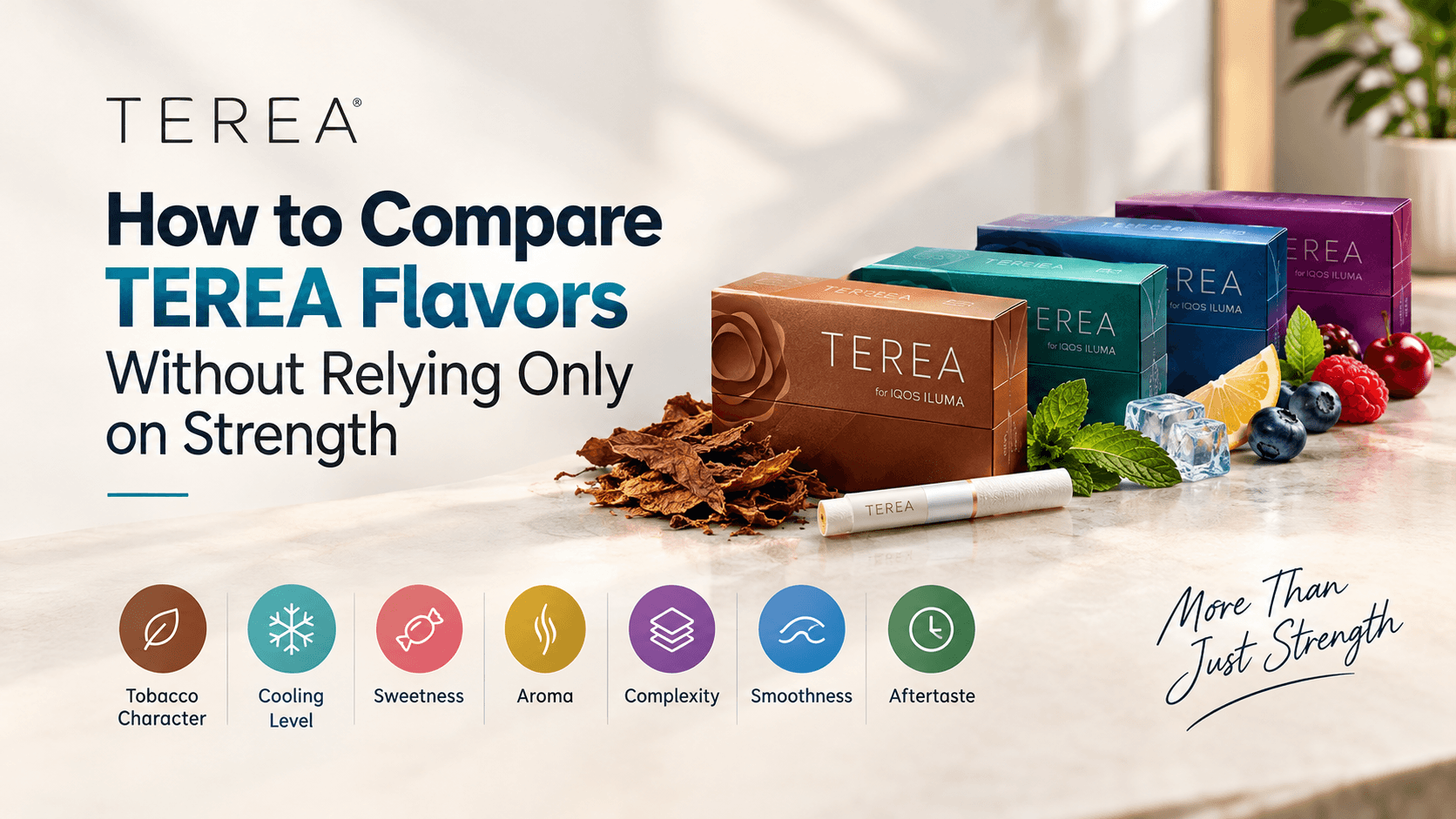
Most people approach TEREA flavor comparisons the same way. They look at a label, see words like mild, medium, or bold, and use that as their main reference point. It is a reasonable starting point but not a complete one. Two TEREA variants can share a similar perceived strength while differing considerably in tobacco character, cooling level, sweetness, aroma, aftertaste, and overall complexity. If you have ever switched to a new TEREA flavor expecting a similar experience to your usual one and found it noticeably different despite having the same strength label, this is exactly why. This guide gives UAE smokers a more practical framework for comparing TEREA flavors, covering everything that actually shapes the experience beyond the strength number. Whether you are working through the full TEREA flavors range for the first time or trying to find an alternative to a flavor you already know, the approach here will help you make a more informed decision.
What Strength Actually Tells You and What It Does Not
When most people describe a TEREA flavor as strong, they are usually referring to one or more of the following: tobacco intensity, throat sensation, cooling impact, or overall flavor presence. The problem is that all of these are different things. A flavor can feel intense because of a heavy tobacco character, or it can feel noticeable because the cooling is assertive, or because the aroma is particularly prominent. Strength and flavor character are not the same thing, and treating them as equivalent is where most comparison mistakes happen.
A stronger-feeling TEREA flavor is not automatically richer, more complex, or more satisfying. Similarly, a lighter variant is not automatically simpler or less interesting. TEREA Smooth Regular is a good example of this. It sits on the lighter end of the tobacco intensity scale but has a clearly defined character that many experienced IQOS users in Dubai and Abu Dhabi reach for specifically because of how clean and consistent it is. Strength alone would not tell you that.
Start With Tobacco Character Before Anything Else
For most traditional TEREA profiles, tobacco character is the most important comparison point and the one that gets the least attention. Tobacco notes across the TEREA range can read as light, smooth, dry, woody, nutty, rich, deep, or roasted. Two variants can have identical perceived strength while tasting completely different from each other simply because their underlying tobacco character sits in a different part of that spectrum.
Shifting the Comparison Question
Instead of asking which flavor is stronger, the more useful question is what kind of tobacco character each one has. This single shift in perspective will immediately give you more useful information. For example, TEREA Bronze Indonesia and TEREA Amber Uzbekistan are both fuller-bodied tobacco options, but they sit in different parts of the tobacco character spectrum. Bronze leans warmer and richer while Amber is more rounded and slightly nutty. Neither is simply stronger or weaker than the other. They are different in character, which is what actually matters when you are trying to find the right fit.
| Comparison Factor | Flavor A | Flavor B |
|---|---|---|
| Tobacco intensity | Medium | Medium |
| Tobacco character | Woody | Nutty |
| Sweetness | Low | Medium |
| Cooling | Light | None |
| Finish | Dry | Smooth |
This kind of comparison immediately shows why two similarly-strength flavors can produce very different experiences. The tobacco character, sweetness, cooling, and finish are where the real differences live.
Flavor Intensity Is Not the Same as Flavor Complexity
This is one of the most useful distinctions to understand when you want to compare TEREA flavors properly. Intensity refers to how noticeable a particular flavor feels. Complexity refers to how many different sensory elements you can identify throughout the session. A flavor can be high intensity but simple, delivering one prominent note consistently from start to finish. Another can be lower in intensity but complex, offering a progression of different notes that change as the session develops.
Why This Matters in Practice
A TEREA variant with a prominent, assertive tobacco note may feel intense on the first draw but straightforward across the full session. Another may open with tobacco, develop aromatic or herbal notes through the middle, and finish with a cooling or smooth quality, making the overall experience feel more layered without necessarily being stronger at any single point. Users in Sharjah and Ajman who are new to TEREA and looking for something more interesting than a standard tobacco profile often find that complexity is actually what they are looking for rather than strength. The full TEREA flavors guide for IQOS ILUMA covers the range in enough detail to help identify which variants offer that kind of progression.
Cooling Is Its Own Dimension
For menthol and cooling-oriented TEREA variants, using strength as the main comparison metric is particularly limiting. Cooling should be evaluated on its own terms: how light or strong the cooling sensation is, when it arrives during the draw, how long it lasts, and whether it supports the tobacco profile underneath or effectively replaces it.
Cooling That Supports vs Cooling That Dominates
The most useful question to ask about any cooling TEREA variant is whether the cooling works with the tobacco character or works against it. TEREA Bright Menthol delivers a clear menthol sensation that sits over a light tobacco base, with the cooling doing most of the experiential work. TEREA Tropical Menthol layers cooling over a fruit-influenced tobacco character, giving the cooling a different context entirely. Both are menthol options but they are not interchangeable, and comparing them only by cooling strength misses what actually makes them different. For a direct comparison across the menthol range, the TEREA Blue vs TEREA Green menthol comparison is a useful reference.
Sweetness Changes the Entire Feel of a Flavor
Sweetness is another factor that can make two similarly-strength TEREA variants feel quite different. A sweeter profile tends to feel more rounded and approachable. A drier profile lets the tobacco character come through more directly. The key distinction is that sweetness is not the same thing as flavor strength. A noticeably sweeter TEREA variant can feel more present or prominent without having a stronger tobacco character at all. When comparing flavors, evaluate sweetness as its own category rather than folding it into a general strength impression.
Ask whether the sweetness is subtle and supportive, moderate and noticeable, or prominent enough to shape the overall character of the session. This single addition to your comparison process will immediately give you more useful information than a strength label alone. For UAE smokers comparing tobacco-forward options, the TEREA Bronze vs Amber guide for UAE covers exactly this kind of nuanced comparison.
Evaluate Aroma and Taste as Separate Things
What you smell and what you taste are not always identical, and this distinction is worth paying attention to when you compare TEREA flavors. Some variants have a prominent aroma that creates a strong first impression before and during the session, while the taste itself is relatively understated. Others have a quieter aroma but a more persistent and developed taste that becomes clearer as the session progresses.
Breaking Down the Sensory Experience
When comparing two TEREA options side by side, it helps to evaluate each one across these categories separately. What stands out in the aroma before the draw begins? Is the aroma tobacco-forward, woody, nutty, or does it carry a cooling or herbal quality? Then during the draw, what is noticeable? Does the tobacco remain dominant throughout, or does something else become more prominent toward the finish? This level of attention gives you a much more complete picture than simply noting which one felt stronger on the first draw.
Pay Attention to How a Flavor Develops Across the Session
Judging a TEREA flavor only from the first few draws is like judging a meal from the first bite. Some flavors open strongly and then settle into something quieter and more consistent. Others start clean and develop more character as the session progresses. Two variants may open with a similar tobacco impression but diverge noticeably in the middle and finish of the session. Breaking the experience into three phases is a practical approach. The opening note is what arrives first. The middle development is what becomes noticeable as the session progresses. The finish is what remains after each draw. For richer tobacco options like TEREA Sienna Indonesian, the development across the session is part of what makes them interesting. A quick first-draw assessment would not capture that at all.
Aftertaste and Smoothness Are Not the Same as Strength
Two important comparison factors that most basic flavor guides overlook are aftertaste and smoothness. Aftertaste refers to what lingers after each draw: whether the tobacco character remains, whether cooling persists, whether the finish is dry or smooth, and how quickly the overall impression fades. A flavor with a long, pleasant aftertaste can feel more satisfying than a stronger one that disappears immediately after each draw. Smoothness is equally distinct from strength. A flavor can have a noticeable tobacco intensity while still feeling smooth in how it delivers that intensity. Conversely, a lighter flavor can feel sharper if its cooling is assertive or its tobacco character has a dry, textured quality. Evaluating smoothness separately from strength gives you a much clearer picture of which TEREA variant will actually suit your preferences for daily use. The guide to the strongest TEREA sticks for UAE smokers makes exactly this distinction for users who specifically want a stronger hit alongside other flavor qualities.
A Practical Comparison Framework You Can Use Every Time
Rather than relying on a single strength descriptor, use this scorecard to compare any two TEREA variants consistently. Rate each category from 1 to 5 based on your own perception.
| Category | Flavor A Score | Flavor B Score |
|---|---|---|
| Tobacco character | /5 | /5 |
| Tobacco intensity | /5 | /5 |
| Cooling level | /5 | /5 |
| Sweetness | /5 | /5 |
| Aroma | /5 | /5 |
| Flavor complexity | /5 | /5 |
| Smoothness | /5 | /5 |
| Aftertaste | /5 | /5 |
This is not an official rating system. It is simply a consistent way to compare flavors according to your own preferences rather than relying on whatever label happens to be printed on the pack. Over time, filling this in for the variants you try builds a clear picture of what your actual taste preferences are, which makes every future purchase more accurate. The complete TEREA buying guide for UAE customers covers the full range in a way that pairs well with this approach.
How to Choose Based on Your Actual Preferences
Once you understand the dimensions beyond strength, matching a TEREA flavor to your preferences becomes much more straightforward.
- If you prefer tobacco-forward profiles: look for lower sweetness, limited cooling, dry or woody notes, and a clean finish. Options like TEREA Balanced Regular or TEREA Rich Regular sit firmly in this category.
- If you prefer cooling profiles: prioritize cooling intensity and duration, menthol presence, and a clean finish. Look at the menthol range including TEREA Menthol and TEREA Purple Menthol.
- If you prefer balanced flavors: look for moderate tobacco intensity, controlled sweetness, moderate cooling, and a smooth finish. TEREA Warm Regular is a good reference point for this kind of profile.
- If you prefer complex profiles: pay attention to flavor progression, aroma development, and a changing finish. Indonesian variants like TEREA Dimensions Apricity Indonesian tend to offer more of this layered quality.
Where to Buy TEREA Flavors in UAE?
If you are based in Dubai, Abu Dhabi, Sharjah, or anywhere across the UAE and want to work through the TEREA range using this comparison approach, Relx Dubai stocks a wide selection of TEREA variants including Indonesian, Uzbekistan, Kazakhstan, and Japan options alongside the standard UAE range. All products come in original sealed packaging. Orders are delivered fast across all seven emirates with cash or card on delivery and nothing required upfront.
Final Thoughts
Strength is one data point. It tells you something useful but not everything you need to make a good decision about which TEREA flavor to try next. A meaningful comparison covers tobacco character, flavor intensity, complexity, cooling, sweetness, aroma, smoothness, and aftertaste. The strongest TEREA variant is not automatically the richest, the smoothest, or the most complex. Looking at the complete profile gives you a far more reliable basis for finding the right fit for your preferences, which ultimately saves you a lot of unnecessary trial and error along the way.
Frequently Asked Questions
Is TEREA strength the same as flavor intensity?
Not always. Strength and flavor intensity can overlap but they are not identical. A flavor can feel intense because of assertive cooling or a prominent aroma rather than a strong tobacco character. Evaluating them separately gives you a more accurate picture of what you are actually experiencing.
Can two TEREA flavors have the same strength but taste very different?
Yes. Their tobacco character, cooling level, sweetness, aroma, and finish can all differ significantly even when their overall perceived strength is similar. This is exactly why strength labels alone are not enough for a useful comparison.
What should I compare besides TEREA strength?
Focus on tobacco character, cooling intensity and duration, sweetness level, aroma, flavor complexity, smoothness, and aftertaste. These seven factors together give you a complete picture of any TEREA variant.
Does a stronger TEREA mean more flavor?
Not necessarily. A flavor can feel noticeable because of cooling or aroma rather than tobacco intensity. Some of the most flavor-rich TEREA options in the range are not the strongest in terms of tobacco intensity.
Why does one TEREA flavor feel smoother than another?
Perceived smoothness is influenced by the balance of tobacco character, cooling level, sweetness, and overall flavor profile. A lighter tobacco intensity with assertive cooling can actually feel sharper than a fuller tobacco profile with moderate sweetness and a clean finish.
How can I compare TEREA flavors more accurately going forward?
Use the same categories every time you try a new variant. Rate tobacco character, cooling, sweetness, aroma, complexity, smoothness, and aftertaste consistently and you will build a clear picture of your preferences over time that makes future purchases much more reliable.